

The offering memorandum opens to a tidy expense page, and the property-tax line looks settled. Last year’s bill is printed in black. The trailing statement carries the same figure. It is tempting to drop that number into year-one net operating income (NOI) and move on to rent growth.
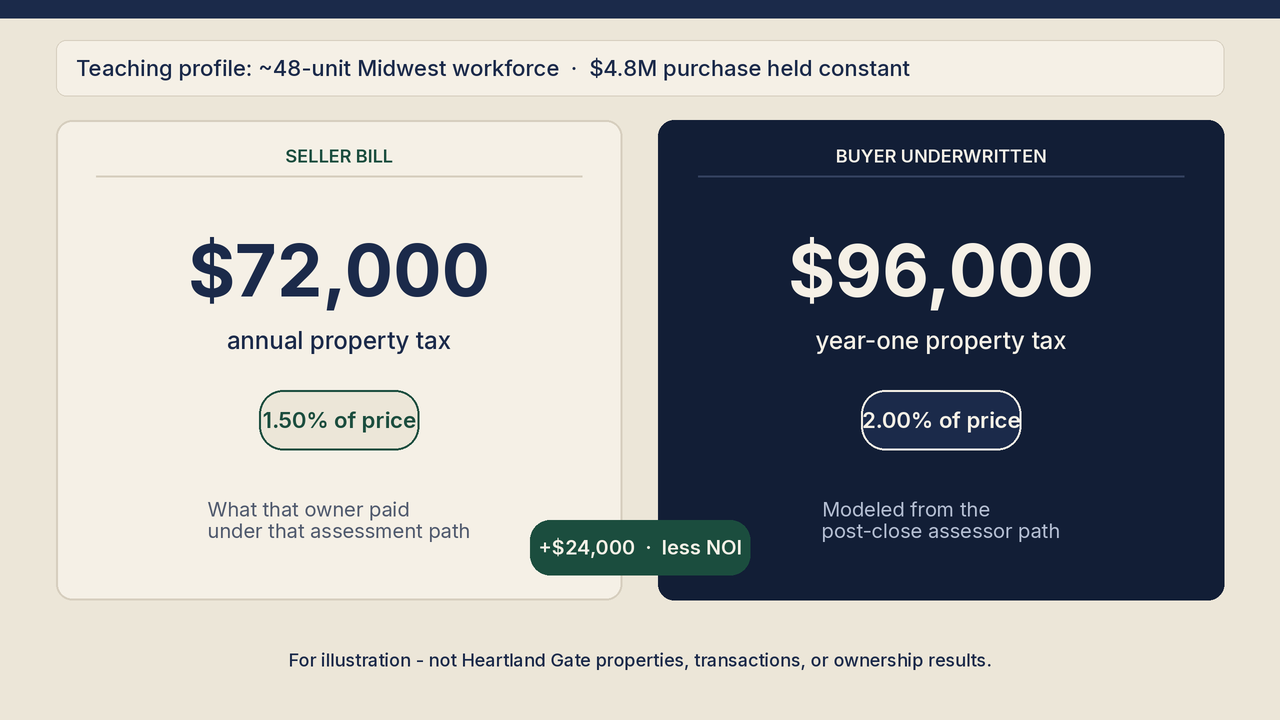
That is where discipline tends to slip. Whether you are underwriting the purchase yourself or judging a sponsor who is, the seller’s tax bill is evidence of what that owner paid under that assessment path, not automatically a forecast of what you will pay after closing. In the Midwest illustration below, underwriting $96,000 of year-one tax instead of copying the $72,000 seller bill leaves about $24,000 less NOI on the page.
We at Heartland Gate refuse to underwrite year-one NOI from the seller’s tax bill alone. The closing can change the question the tax record was answering. Until the assessor path after an arm’s-length sale is stated and a buyer tax line is modeled from that path, the offering memorandum figure is a starting map, not the answer.
Never underwrite year-one NOI from the seller’s tax bill until the county or state assessment path after sale is on the table, and a buyer tax line is modeled from that path (plus levy and rate risk), not copied from the seller.
What the offering memorandum tax line is selling
A tax bill is assessed (or equalized) value times local rates, minus exemptions or abatements that still apply. Assessed value is the valuation entered for taxation. The bill is the cash result. A sale can move the value path without the bill moving one-for-one if rates roll back, caps apply, circuit breakers hit, or an appeal succeeds.
Most of the Midwest systems we care about fix value as of a statutory assessment date, commonly January 1. Closing mid-year usually does not rewrite that year’s assessment-date liability by itself; proration is typically contractual. Underwriting still has to care about the next assessment path once ownership and the recorded sale are in the record.
So the offering memorandum tax line is useful and incomplete as buyer evidence. Treating it as year-one fact silently pollutes trailing and forward NOI. Taxes are a normalization line. Rebuilding them is part of the work; it is not the same job as rebuilding a trailing statement into buyer NOI (see T-12 Normalization: The Seller’s NOI Is a Starting Point, Not the Answer).
One Midwest illustration
Here is how the gap shows up on a package we might screen. For illustration: a 48-unit Midwest workforce multifamily profile at a $4.8 million purchase price held constant. The figures are round teaching assumptions, not a Heartland Gate property, transaction, or ownership result.
The seller materials show a current annual property tax of $72,000 (1.50% of price). After asking the assessor-path questions, a disciplined buyer underwrites $96,000 for year-one tax (2.00% of price): assessed value moving partway toward sale-implied market over assessment-date and cycle timing, not a day-one full reset. The delta is +$24,000. All else equal on NOI, year-one income is $24,000 lower than a model that copied the seller bill.
| Seller bill (shown) | Buyer underwritten (year-one) | |
|---|---|---|
| Annual property tax | $72,000 | $96,000 |
| As % of $4.8M price | 1.50% | 2.00% |
Every tax dollar above is an assumption except the arithmetic (96,000 – 72,000 = 24,000; the two percentages). This is not a claim that Midwest taxes always rise by a third, and not a county forecast. A careful buyer might underwrite a range: seller bill as an optimistic floor, a higher path in the model, and appeal or abatement options noted, without pretending any one outcome is guaranteed.
What a sale does (and does not do) in our Midwest target states
Across Indiana, Illinois collar counties, Wisconsin, Kentucky, and Missouri, sales information influences assessed value somehow. In none of those states is it accurate to write that Midwest taxes always double the day after closing. Timing, uniformity, classification, levy mechanics, and appeals sit between sale price and the buyer’s check. Ask the assessor; county practice is not regional law.
Indiana runs annual trending and a cyclical physical reassessment, not a California-style automatic transfer reset keyed only to the deed. Prior-year area sales feed annual adjustment / trending. One closing does not rewrite statewide law; it can still move the sales sample that later touches your parcel.
Illinois collar counties revalue non-farm property every four years outside Cook’s triad, and may correct values between general years when they are wrong. Transfer alone is not a statewide Prop 13-style reset. Property Tax Extension Limitation Law (PTELL) caps constrain taxing-district extensions, not one parcel’s bill at the Consumer Price Index (CPI). The Illinois property tax system guide is the public map; Cook triad rules are not collar practice.
Wisconsin treats a recent arm’s-length sale of the subject as primary valuation evidence under Wis. Stat. §70.32, so a closing can drive a higher assessment path. Uniformity still matters: §70.365 generally stops an assessor from changing the subject solely on that sale without adjusting comparables in the same market area.
Kentucky assesses at estimated fair cash value, with continuous updates and annual revaluation authority. Deed value from a prior-year purchase may be considered for the following January 1 if nothing material changed. Closing later does not, by itself, rewrite the January 1 assessment date.
Missouri runs a two-year reassessment cycle. Odd-year value generally carries into the next even year except for physical changes. Classification (residential vs commercial assessed percentages) changes bill math. A deed is not an automatic every-transfer reset; sale year versus the next odd-year reassessment changes when assessed value can catch market.
Sales move the value conversation. Mechanisms differ. Copying folklore from one state onto another is how these articles go false.
Questions that force the tax story open
You do not need to become the county’s appraiser. You need the questions that make the post-close path explicit.
- What assessment date will first reflect our ownership and this sale?
- Is this county in a general or cyclical reassessment year for this parcel?
- Does local practice treat our arm’s-length sale as primary evidence, as one comparable among many, or mainly through trending and ratio studies?
- What is current assessed (or equalized) value versus purchase price, and how is the asset classified?
- Does any abatement, tax increment financing (TIF), incentive, or exemption end at transfer?
- What are the appeal or conference deadlines after notice?
- Separately, what is the levy and rate trend even if assessed value is unchanged?
A seller who has already modeled buyer tax can walk those answers. Vague answers are information.
If you are judging a sponsor rather than underwriting the purchase yourself, the same list becomes a test of the sponsor. Ask which of these questions they put to the assessor or broker, and what tax path they actually modeled.
When the seller bill is still useful
Sometimes the seller tax is already near sale-implied value: recently trended, revalued in-cycle, or bought not long ago at similar pricing. Asking the assessor-path questions then confirms the line rather than destroying it. Higher assessed value can also meet lower rates, rollbacks, circuit breakers, extension caps, or a successful appeal, so an assessed-value shock is not automatically an NOI shock of the same percent. Appeal rights are real; underwriting still should not assume the win.
The seller bill remains useful as history, parcel detail, and a prompt for the questions above. It is a map to the tax record, not proof the buyer’s year-one line will match it.
The rule we work by
Never assume seller expenses continue unchanged after sale. Watch property-tax reassessment after acquisition as a named concern: is the path predictable, and what happens after a sale?
Refuse to underwrite year-one NOI from the seller’s tax bill alone. Use a documented post-close tax scenario or reserve until the assessor path, timing, classification, exemptions, and levy assumptions are supported. Verify the path. Skip the “double the taxes” theater. For how we frame acquisition screens more broadly, see What we look for.
The seller’s tax bill answers what that owner paid. Year-one underwriting asks what you will pay after the sale.
Keep reading
Primary: Heartland Gate Operating Notes. Educational updates on capital, risk, operations, and acquisition screens. Subscribing is educational access to writing. It is not investment access and not an offering.
Sibling: T-12 Normalization: The Seller’s NOI Is a Starting Point, Not the Answer. Taxes are one normalization line; that piece owns rebuilding trailing statements into buyer NOI.
Sibling: The Five Numbers We Want Before Believing a Value-Add Rent Story. Renovation rent upside is a separate proof path from verifying today’s expenses.
Philosophy / About: Our Philosophy · About Heartland Gate
By Bob Ewoldt · Last reviewed September 28, 2026
This article is general educational content on multifamily acquisition discipline and property-tax underwriting after closing. It is not an offer to sell or a solicitation to buy any security. It is not investment, legal, or tax advice. It does not determine investor eligibility. Illustrative figures are teaching assumptions and calculations, not performance results. Mechanisms described are public-proxy educational framing for Indiana, Illinois collar counties, Wisconsin, Kentucky, and Missouri and are not legal advice for a specific parcel. Private securities involve substantial risk, including loss of capital and limited liquidity. Consult qualified professionals before making investment decisions.
Leave a Reply