

The pitch deck opens with a clean five-year internal rate of return (IRR). Rent growth is tidy. The renovation finishes on schedule. Year five shows a sale at an exit capitalization rate that looked reasonable the day the slides were printed. If you are a passive investor reading that packet, or an owner underwriting a purchase, the five-year sale can feel like the plan, not an option.
Here is why that matters to you. Modeling an exit is underwriting discipline. Depending on an exit is a hidden deadline. When the property only “works” if someone buys it in a narrow window at a friendly exit cap, the five-year case is no longer a comparison tool. It is a rescue requirement wearing an IRR label.
Walk the question with us the way we ask it on deals we screen. Same building. Same rent roll. Same expense rebuild. We put a conventional five-to-seven-year case on the page for comparison, then ask separately whether ownership remains economically rational at 10, 20, or 30 years if the sale window does not cooperate. The point is not to forecast decades with false precision. It is to test whether the model contains a forced sale or refinance event that the acquisition thesis cannot survive without.
Decision rule: A five-year sale should improve optionality, not rescue the investment thesis. Model the exit. Do not depend on it.
We at Heartland Gate treat a five-year sale as optionality, not a requirement. Continued ownership should be able to remain rational for 10, 20, or 30 years if market conditions make a sale unattractive. That is a durability screen, not a claim that longer ownership eliminates risk or that “always hold forever” is universal strategy.
Hold period, exit assumptions, and durability
Modeled hold period, exit cap (terminal capitalization rate), and terminal value are assumptions built for comparison. We model an initial 5 to 7 year investor case, then test whether ownership remains economically rational at 10, 20, or 30 years if the sale window does not cooperate. Cap-rate compression should not be the base case; we stress wider exit caps. Optionality means selling at year five improves outcomes relative to continued ownership, while base economics remain acceptable if the owner holds or refinances under stressed assumptions. Rescue means without a sale (or refinance) in a narrow window at a favorable exit cap or rate, cash flow, equity multiple, or solvency fails.
How a five-year model becomes a hidden deadline
Investor presentations often lead with that tidy five-year IRR. The model assumes rent growth, expense control, a renovation program that finishes on schedule, and a sale at an exit cap that looks reasonable on print day.
That package can be internally consistent and still fragile.
Fragility shows up when we ask a different question: what if we cannot sell? Or: what if takeout rates are higher and refinance proceeds do not clear the loan?
Those questions are not pessimism. They are how we separate a comparison tool from a rescue requirement.
Industry backdrop in 2025-2027 has made the timing risk easier to see in public discussion. Legal and trade commentary has described large multifamily maturity volumes, refinance gaps where low-coupon originations meet higher takeout rates, and distress that is often debt- and timing-driven rather than occupancy-collapse-driven. Treat those maturity-wall volume claims as source claims with dated citations, not as settled totals for every market. Freddie Mac’s multifamily market metrics also show why exit markets are not a constant: apartment vacancy was 6.8% in 2Q 2026, with quarterly effective-rent change of +0.8% that quarter (Moody’s Analytics via Freddie’s Form 10-Q table). Freddie’s January 2025 Multifamily Outlook framed baseline 2025 rent growth at 2.2% and vacancy near 6.2%, while noting elevated and volatile rates pressuring values. Use that material as context for exit-market uncertainty, not as a forecast of any specific deal’s exit cap.
None of that proves a named property must sell badly. It does explain why a model that needs a cooperative exit year is not the same as a model that merely includes one.
A year-five decision path (not a rescue story)
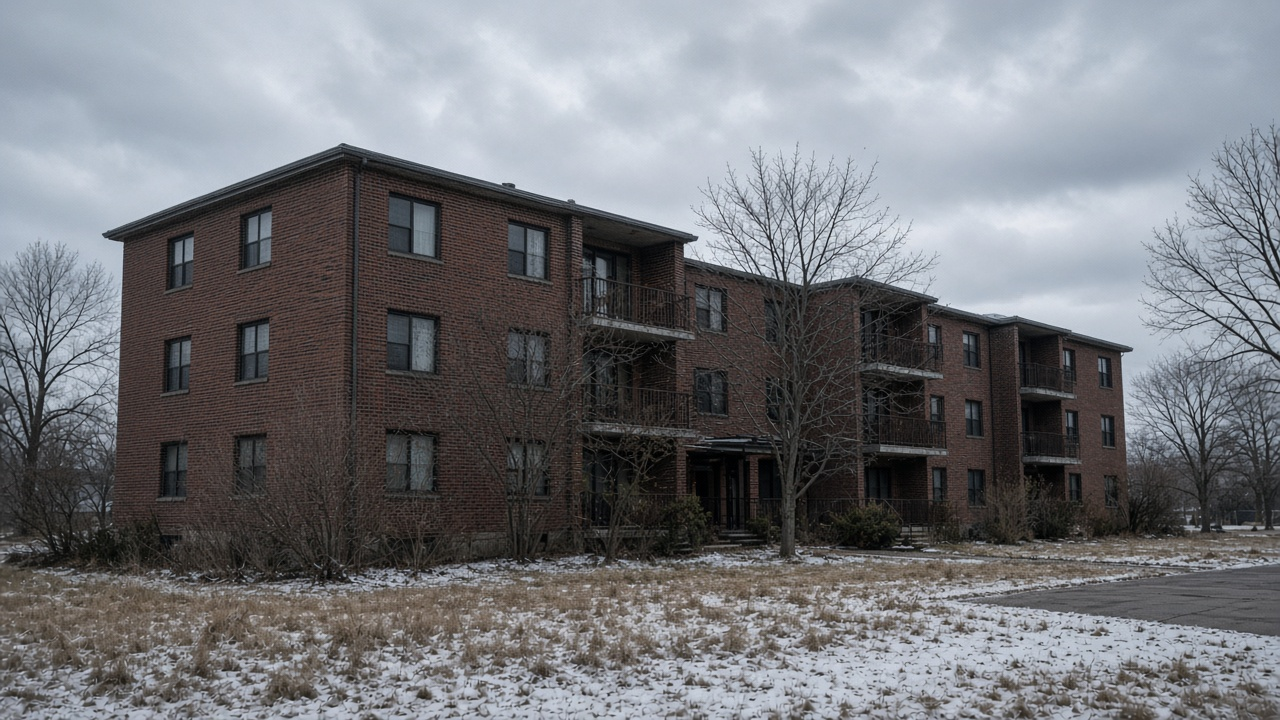
For illustration, consider a stylized ~48-unit Midwest workforce multifamily profile. Round numbers. Every path outcome is a calculation on assumptions. These figures are teaching tools. They are not comps, not market averages, and not Heartland Gate properties, transactions, or ownership results. Selling-cost and rate inputs are illustrative and dated, not quotes.
Deal frame (illustrative)
| Item | Value |
|---|---|
| Units | 48 |
| Purchase price (Year 0) | $4,800,000 |
| Stabilized NOI (net operating income) (Year 5 run-rate) | $320,000 |
| Acquisition fixed-rate loan | $3,360,000 (70% loan-to-value, or LTV), 10-year term, 30-year amort, 5.75% coupon |
| Remaining loan balance at Year 5 (approx.) | ~$3,120,000 |
| Modeled “base” exit cap | 6.50% |
| Stressed exit cap | 7.50% (+100 bps) |
| Selling costs | 4.0% of gross sale price (within a commonly discussed negotiated ~3%-6% commission band plus other closing costs) |
| Year-5 refinance takeout rate (illustrative) | 6.50% fixed (dated market-context band, not a quote) |
| Refinance sizing rule | Lesser of 70% LTV (loan-to-value) at stressed value and 1.25x DSCR (debt service coverage ratio) |
Year-5 pathways (illustrative)
| Path | Key math | Investor takeaway |
|---|---|---|
| A. Sell at base exit cap 6.50% | Gross value = 320k / 0.065 ≈ $4.92M; net after 4% costs ≈ $4.72M; equity after debt ≈ $1.60M | Looks “fine” versus roughly $1.44M initial equity, but only if the exit market cooperates |
| B. Sell at stressed exit cap 7.50% | Gross value = 320k / 0.075 ≈ $4.27M; net after 4% ≈ $4.10M; equity after debt ≈ $0.98M | Thin / impaired relative to contributed equity; the sale no longer rescues returns |
| C. Refinance at higher rate, hold | Value for LTV (use stressed 7.50% value $4.27M): 70% ≈ $2.99M proceeds < ~$3.12M payoff → equity check may be needed; DSCR at the higher rate may further constrain | Maturity / refinance risk exists even with fixed acquisition debt |
| D. Hold without sale or cash-out | Requires adequate DSCR on existing debt, reserves for CapEx (capital expenditures), and acceptable cash yield with no liquidity event | The durability question the long-hold test asks |
Path A can make a fragile thesis look successful. Paths B through D reveal whether year five was optionality or a deadline.
A simple decision tree helps: at year five, Sell (base vs +100 bps exit cap), Refinance (higher takeout and possible equity check), or Hold (cash yield, DSCR, and reserves). The footer for any visual should stay explicit: teaching illustration, not a Heartland Gate property.
What we underwrite beyond the five-year IRR
Our business thesis treats a five-year sale as an option, not a requirement. Continued ownership should be able to remain rational for 10, 20, or 30 years if market conditions make a sale unattractive. The same conservatism says not to require a refinance, recapitalization, or sale inside a narrow window for the deal to remain viable, and notes that fixed-rate debt still has maturity risk.
The long-hold durability test sits beside the conventional five-to-seven-year exit case. We stress exit caps wider (base, +50 bps, +100 bps, +150 bps where appropriate). We do not make cap-rate compression the base case. We ask whether ownership without a liquidity event still makes economic sense under conservative operations.
Our buy-box avoid list is blunt for a reason: deals whose five-year exit is necessary to avoid weak long-term economics, and deals that require a refinance or recap to make base economics acceptable, fail the screen even if the five-year IRR looks strong.
Practical "hidden deadline" checklist
Use this as a notebook, not a verdict machine.
- Equity multiple / cash yield without a sale. Do interim distributions and remaining equity economics remain acceptable if the asset is not sold?
- DSCR if NOI is flat or −10%. Can the loan still clear coverage without heroic rent growth?
- Refinance at maturity under higher rates. If takeout rates are +150 to +250 bps and LTV/DSCR constrain proceeds, is an equity check required?
- Exit-cap stress. What happens to net equity at +100 / +150 bps wider exit caps after selling costs?
- Transaction-cost drag. Do thin equity gains disappear after negotiated commissions and closing costs (illustrative industry discussion often cites roughly ~3%-6% commission bands that scale with deal size, plus legal and title costs; use as assumptions, not a universal rule)?
- Reserves and CapEx. Can the owner fund recurring capital without forcing a sale?
- Ownership without a liquidity event. Is continued hold economically rational, or only “acceptable” if someone buys the story at year five?
Agency product structure reinforces the maturity point even when the acquisition loan is fixed. Fannie Mae’s Fixed-Rate Mortgage Loans Term Sheet describes terms of 5-30 years, amortization up to 30 years, conventional maximum LTV of 80%, and minimum DSCR of 1.25x (product-specific exceptions exist). Predictable payments matter. They do not erase a contracted maturity date that must be planned for.
Sibling capital-structure discipline lives in Why Fixed-Rate Debt Is a Business-Plan Decision. Fixed-rate acquisition financing reduces payment volatility. It does not turn the loan into permanent capital.
Some strategies are intentionally shorter-duration and can be well structured: a bridge-to-agency value-add plan with an explicit capital stack, for example. Critiquing forced timing is not the same as declaring every short hold reckless.
Long holds create their own risks. CapEx and obsolescence accumulate. Tax reassessment paths change. Insurance can reprice. Neighborhoods shift. Property-management quality drifts. Key-person risk does not disappear because the model extends to year thirty. Passive investors also have liquidity preferences that a long-hold thesis must disclose honestly in offering documents. This article does not ask anyone to accept indefinite illiquidity without reading those terms.
A modeled five-year sale can be honest communication for comparing deals. The problem appears when the only acceptable equity outcome requires that sale at a friendly exit cap.
Refinance markets are not permanently closed. Agency capacity and origination volumes can improve; Freddie’s outlook themes have discussed recovery paths even while noting volumes below prior peaks. Still test the deal if they do not.
And fixed-rate acquisition debt is not a free pass. It reduces payment volatility. It does not erase maturity risk. We do not claim a property can always refinance, that holding longer eliminates risk, or that longer ownership guarantees recovery.
The issue is forced timing, not a universal preference for never selling.
Decision rule, restated
If selling at year five improves an already durable outcome, the exit is optionality.
If the investment thesis collapses without that sale (or without a cooperative refinance), the five-year model was a rescue plan wearing a comparison label.
We screen accordingly. We prefer acquisitions that remain economically rational under longer-hold and maturity stress even when the five-year IRR looks strong. We refuse, or heavily restructure, packages that fail those tests.
A five-year sale should improve optionality, not rescue the investment thesis. Model the exit. Do not depend on it.
Sources
External references that inform the hold-period and exit-risk framing in this article:
- Fannie Mae Fixed-Rate Mortgage Loans Term Sheet (accessed 2026-09-07). Terms of 5-30 years; amortization up to 30 years; conventional maximum LTV 80%; minimum DSCR 1.25x (product-specific exceptions exist).
- Freddie Mac Form 10-Q, 2Q 2026, Table 14 (accessed 2026-09-07). National apartment vacancy 6.8% in 2Q 2026; quarterly effective-rent change +0.8% (Moody’s Analytics via Freddie).
- Freddie Mac 2025 Multifamily Outlook (Jan 8, 2025; accessed 2026-09-07). Baseline 2025 rent growth 2.2%; vacancy near 6.2%; elevated and volatile rates pressuring values.
- Akerman: Multifamily at the Crossroads – The Maturity Wall, the Recovery, and the Decisions (2025-2026 pieces; accessed 2026-09-07). Backdrop on multifamily maturity volumes, refinance gaps, and debt-/timing-driven distress themes.
- Lornell: Commercial real estate broker fees – what sellers actually pay (accessed 2026-09-07). Industry explainer summarizing negotiated CRE broker commissions commonly ~3-6%, often scaling with deal size. Use as an assumption band, not a universal rule.
- PeerSense: CMBS vs Agency (indicative June 21, 2026; accessed 2026-09-07). Indicative agency fixed coupons ~5.85-6.60% desk commentary. Not a quote; label dated.
Claims this article does not make: that long holds eliminate risk; that a property can always refinance; that holding longer guarantees recovery; that investors should accept indefinite illiquidity without reading offering terms; that “always hold forever” is universal strategy; that cap-rate compression is a base case; that indicative coupons or commissions are Heartland Gate quotes or guarantees; that the illustrative pathways are comps, market averages, or Heartland Gate properties or results; that Heartland Gate has executed a specific long-hold exit or distribution result; that Operating Notes subscription provides investment access; that Heartland Gate is offering securities through this page; any projected investor return presented as an expected result.
Keep reading / next steps
Primary: Heartland Gate Operating Notes – educational updates on how we think about capital, risk, operations, and acquisition screens. Subscribing is educational access to writing. It is not investment access and not an offering.
Secondary: Why Fixed-Rate Debt Is a Business-Plan Decision – why acquisition debt structure belongs inside the business plan, and why fixed-rate financing still leaves maturity risk to underwrite.
Secondary: What we look for – the working buy-box hypothesis and the kinds of forced-timing dependencies we prefer to avoid.
Philosophy / About: About Heartland Gate
By Bob Ewoldt · Last reviewed September 7, 2026
This article is general educational content on multifamily capital structure, hold-period underwriting, and exit-risk discipline. It is not an offer to sell or a solicitation to buy any security. It is not investment, legal, or tax advice. It does not determine investor eligibility. Illustrative figures are teaching assumptions and calculations, not performance results. Private securities involve substantial risk, including loss of capital and limited liquidity. Consult qualified professionals before making investment decisions.