
Acquisition Discipline
By Bob Ewoldt · Last reviewed September 6, 2026

This page describes Heartland Gate Capital’s initial working hypothesis for multifamily acquisitions.
It is not a permanent acquisition mandate. It is not an offering. It is not a commitment to buy in any market. It is not a statement of eligibility for any investment.
We wrote it down so brokers, operators, lenders, and curious professionals can see how we are currently screening deals while we test and refine the thesis through underwriting, conversations, tours, and market work.

A working hypothesis, not a finished doctrine
The first stretch of work is meant to pressure-test this buy box. Broker coverage, lender conversations, property-manager interviews, tours, and underwriting will tell us what is too tight, too loose, or simply wrong. We will update the written thesis when evidence supports a change.
Until then, this is how we are looking.
The investment idea in one paragraph
We want to acquire existing multifamily housing where resident demand looks durable, current operations already support meaningful cash flow, basis is attractive relative to comps and replacement cost, and operational problems are identifiable and fixable.
Acquisition debt should be fixed-rate for the contracted term and conservatively sized. The investment should not depend on future interest-rate declines, a forced refinance, or a sale in a narrow window. Value should come from controllable NOI improvement more than from market speculation. The property should have more than one plausible exit path, and continued ownership should still make economic sense if we hold well beyond a five-to-seven-year comparison case.
That is the thesis we are testing.

Property profile we are screening toward
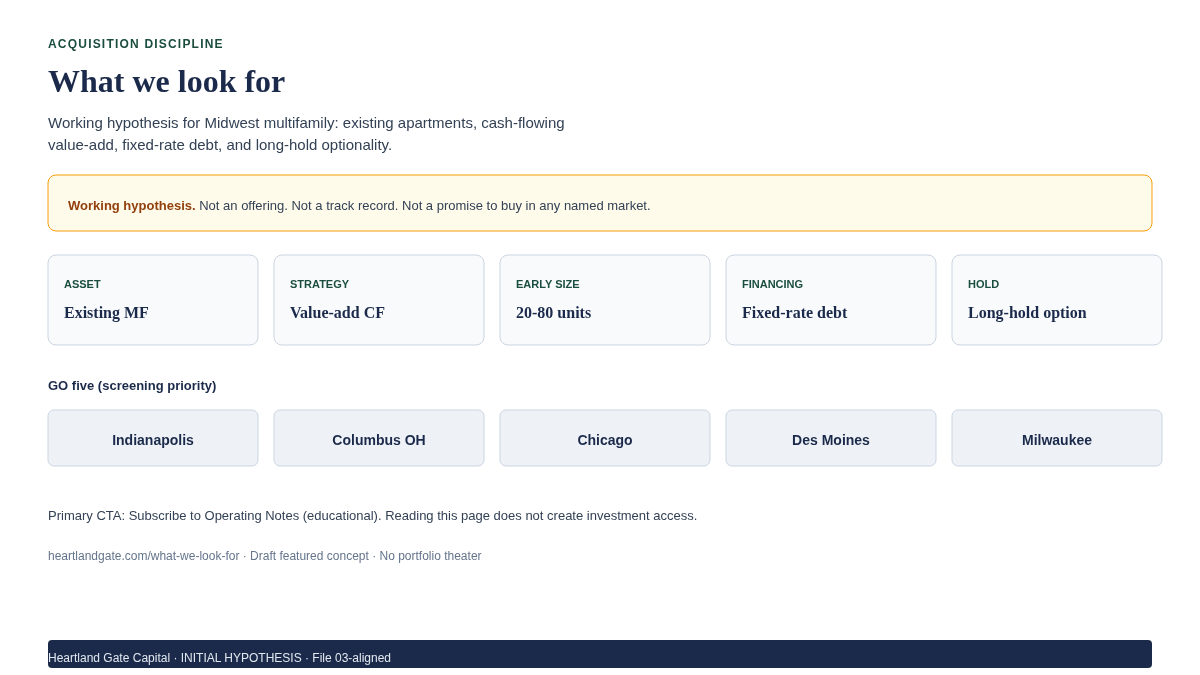
- Asset type
- Existing apartments
- Strategy
- Cash-flowing value-add
- Quality
- Primarily B- / C+ workforce housing where physical condition is manageable
- Early size
- Roughly 20-80 units for a directly led early acquisition; open to co-GP participation in larger properties
- Financing
- Fixed-rate acquisition debt only; conservatively sized; refinance and maturity risk still stress-tested
- Management
- Third-party property management initially; Heartland Gate provides active asset management
- Hold framing
- Model a 5-7 year investor case for comparison; also evaluate 10, 20, and 30 year hold viability. Exit is optionality, not a requirement
We will not force a deal into the unit-count band if the capital structure or operating complexity is wrong.

Where we are looking first
Our initial geographic priority, as a working hypothesis, is five markets:
- Indianapolis
- Columbus, Ohio
- Chicago
- Des Moines
- Milwaukee
That list reflects a Midwest focus and accessibility from the Chicago area for repeated in-person presence. Naming these markets does not mean we will buy there. It means those are the first places we are organizing broker coverage, market learning, and screening attention.
A strong metro can still contain a weak block. A quieter metro can still contain an excellent submarket. Market labels do not replace property-level diligence.
How we prefer to create value
We favor several modest, controllable levers over a single dramatic bet:
- Collections, delinquency, and bad-debt quality
- Leasing conversion and renewals
- Vacancy and unit-turn time
- Maintenance execution and vendor spend
- Utility management
- Property-management accountability
- Unit renovations only where demonstrated rent premiums justify cost
- Other income where fair, legal, and market-supported
- Expense discipline that does not degrade the resident experience
The underwriting question is whether those levers are real at this property, not whether they sound good in a brochure.

What we avoid initially
Educational, not theatrical. These are early filters, not permanent moral judgments:
- Ground-up development
- Large repositionings that require major structural work
- Severe environmental issues, unclear title, or unresolved legal status
- Very high leverage
- Adjustable-rate or floating-rate acquisition financing
- Business plans that fail if rents stay flat
- Deals that need cap-rate compression to work
- Deals that need a refinance or recapitalization to make the base economics acceptable
- Deals whose five-year exit is necessary to avoid weak long-term economics
- Single-employer dependency
- Markets with persistent population or employment deterioration unless basis creates exceptional protection
- Neighborhood or crime problems that operations cannot solve
- Complex affordable-housing restrictions unless paired with experienced partners
- Deals where insurance, property tax, or utilities are not understood
- Thin reserves
- Deals that look attractive mainly because sponsor fees are large
If you are a broker and a package fails several of these filters at a glance, we would rather hear a clear “no fit” than spend everyone’s time on a forced match.
Debt and hold period, in plain terms
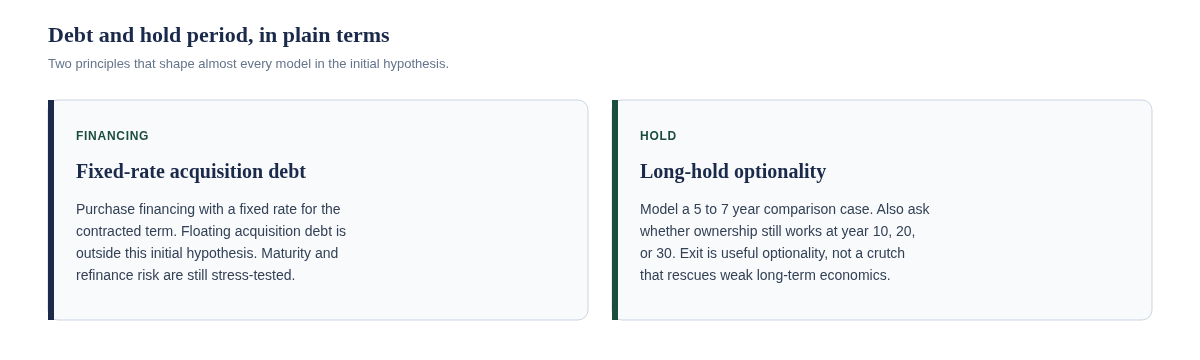
Two points deserve extra clarity because they shape almost every model we run.
Fixed-rate acquisition debt. We underwrite purchase financing with a fixed interest rate for the contracted term. Floating-rate acquisition debt is outside this initial hypothesis. Fixed debt still has maturity and refinance risk; we stress those. Predictable debt service is part of the business plan, not a separate financing afterthought.
Long-hold optionality. We will model a five-to-seven-year investor comparison case. We will also ask whether ownership still makes sense at year 10, 20, or 30. A planned exit is useful optionality. It is not the crutch that makes a weak long-term property look acceptable.
What this page is not
This page is not:
- A track record
- An offering memorandum
- A live raise
- A promise of returns
- A statement of assets under management
- An invitation to “invest now”
- A guarantee that we will acquire in any named market
Keep reading
If you want the financing principle behind the fixed-rate rule, start with Why Fixed-Rate Debt Is a Business-Plan Decision, Not Just a Financing Decision.
If you want how we think about seller NOI versus buyer economics, read T-12 Normalization and Multifamily NOI.
For ongoing notes on how we underwrite and operate, subscribe to Operating Notes.
For how we think about sponsor evaluation, see the Sponsor Evaluation Scorecard when published.
Philosophy and About remain the best places for company posture and background.
Subscribe to Operating Notes
Subscribing to Operating Notes does not provide investor access, an offering, or eligibility.
Read Philosophy · Sponsor Evaluation Scorecard (when published)
Disclaimer
Heartland Gate Capital publishes educational material about multifamily underwriting and acquisition discipline. Nothing on this page is an offer to sell or a solicitation to buy securities. Criteria described here are a working hypothesis subject to change. We may pass on deals that appear to fit, and we may revise the written buy box when evidence supports a change.